
From the Gallery, Artists
Etching: The Art of Line, Metal and Print
Sep
Etching is an art of patience. In it, a line follows an unusual journey: from the artist's hand onto a metal plate, through the action of acid and ink, to the final impression on paper. The result can be delicate and almost ethereal, dramatically dark or rich in detail, yet it always bears the direct trace of the artist's gesture.
What exactly is etching?
Etching is an intaglio printmaking technique. A metal plate, most often copper, is coated with an acid-resistant ground. The artist draws on it with a sharp needle, exposing the metal without cutting directly into it. The plate is then immersed in an acid solution, which bites into the exposed lines, turning them into tiny recesses.
After cleaning, ink is rubbed into these lines and the surface is wiped. The plate and dampened paper then pass through a press under strong pressure. This transfers the image onto the sheet, reversing the drawing on the plate.
From decorating armour to fine art
The technique has its roots in the decoration of weapons and armour. In Germany in the late 15th and early 16th centuries, etching began to be used for printing on paper and soon spread across Europe. Early masters included Albrecht Durer, Parmigianino and Pieter Bruegel the Elder.
The great advantage of etching is the freedom of its line. Unlike traditional burin engraving, it allows the artist to draw on the soft ground in a way similar to working with a pencil or pen. This makes the technique a natural field for experimentation and personal expression.
The world's masters
Rembrandt turned etching into an artistic language in its own right. He reworked his plates, used different kinds of paper and left varying amounts of ink on them, so that impressions from the same plate could convey different moods.
In the 18th and 19th centuries, Francisco Goya combined etching with aquatint, drypoint and other methods to achieve rich tones and a powerful dramatic effect. James McNeill Whistler and Pablo Picasso later turned to the technique, as did David Hockney in the 20th century. Etching has not remained a historical curiosity: it continues to be a living form of artistic thought.
Etching in Bulgarian printmaking
The Bulgarian printmaking tradition also offers remarkable examples. The National Gallery identifies the etchings of Stefan Badzhov and Hristo Berberov among the works connecting the academic tradition with the European influences of Symbolism and Art Nouveau. Petar Morozov's colour aquatints represent an important early achievement in mastering this technique in Bulgaria. More recently, artists such as Lyuben Dimanov, Milko Bozhkov and Dimo Kolibarov have explored different possibilities in etching, aquatint and intaglio printmaking.
Anna Tikhonova-Yordanova and Yulian Yordanov in the Bridges Gallery collection
In the Bridges Gallery collection , etching is represented by compelling contemporary artists. Among them are Anna Tikhonova-Yordanova and Yulian Yordanov : artists with a distinctive visual language in printmaking, in which the figure, myth, nature and symbol create images with many layers of meaning.
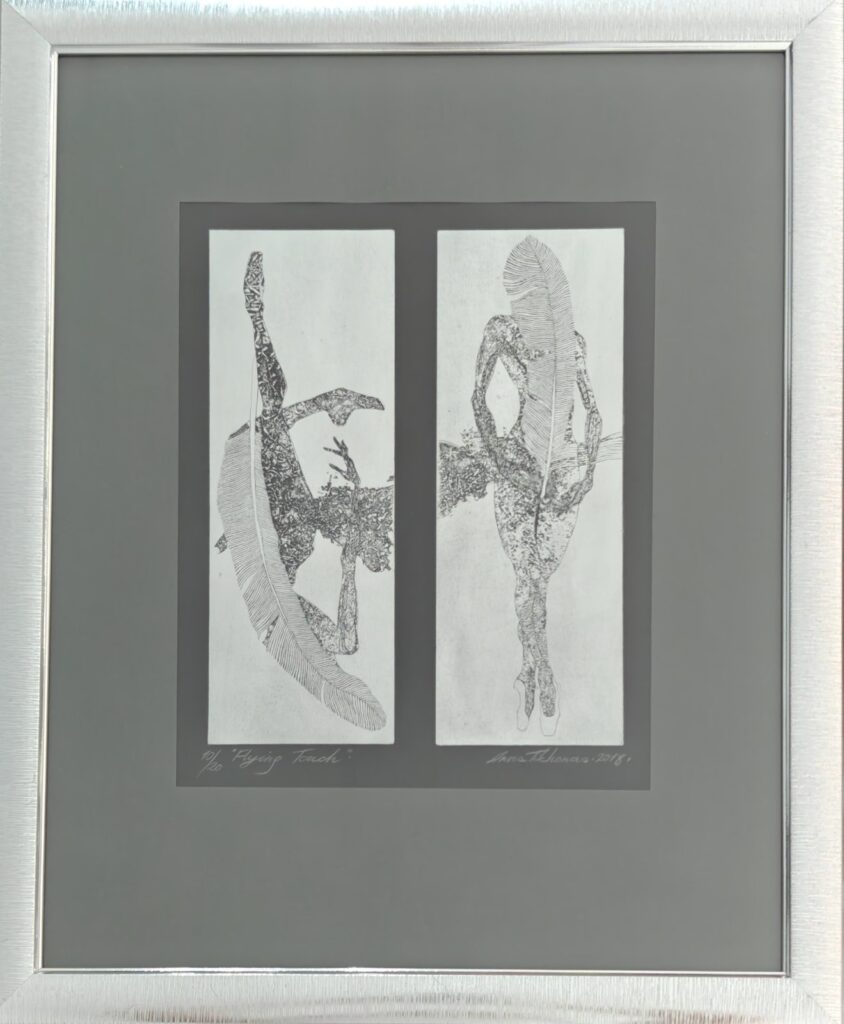
In Flying Touch , the line is both precise and light. The image seems to emerge at the boundary between movement, dream and memory: an example of just how poetic intaglio printmaking can be.
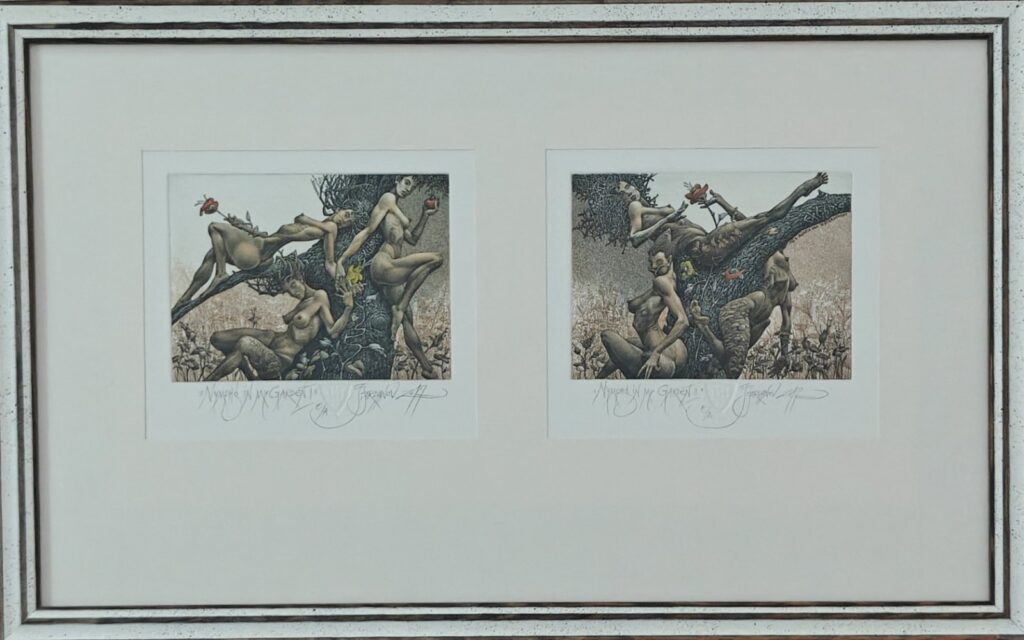
Nymphs in the Garden by Yulian Yordanov takes us into a mythological, contemplative space. The composition shows how colour etching can bring narrative, symbol and movement together in a complex network of lines and tones.
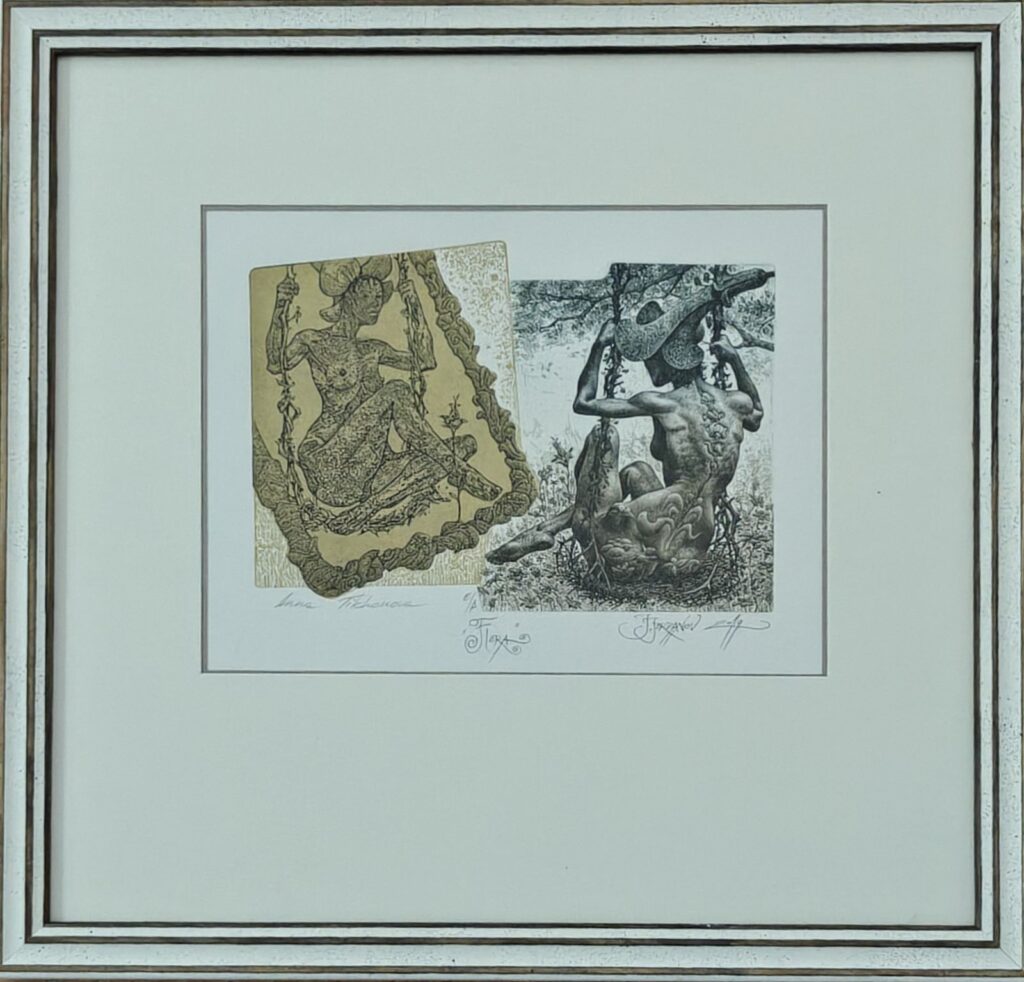
A special place belongs to their collaborative work Flora. It brings two artistic styles together in a single image, reminding us that printmaking can also be a space for creative dialogue.
A curious detail: why are two impressions not always exactly alike?
Even when made from the same plate, impressions can differ. The way the plate is inked and wiped, along with the type and dampness of the paper, affects the final result. The artist may also rework the plate, creating different states of it.
A slightly embossed rectangle can be seen around the edges of many original impressions. This is the trace left by the pressure of the metal plate, known as the plate mark. It is not a defect, but a natural feature of the intaglio printing process.
How should you look at an etching?
Etching rewards a close look. Move closer and follow the line: where it is assured, where it breaks, how it grows denser in the shadows and lets the paper breathe in the lighter areas. Then step back. From dozens and hundreds of small marks, a complete image will emerge.
This is the particular beauty of the technique: it is both material and delicate. Metal, acid, ink and pressure create an image that feels light, personal and almost as though it has been drawn directly onto the paper.
You can also read more about the two artists and their work together in our article on the anniversary exhibition Harmony in Difference.
Explore more etchings in the Bridges Gallery collection.
Factual sources: Victoria and Albert Museum, The Metropolitan Museum of Art, National Gallery of Art, National Gallery, Petko Zadgorski Burgas Art Gallery.

